Saturday, March 27, 2010

Fluorine

Florine is arguably the most volatile and reactive element in the universe. And yet it's in our toothpaste!
check out fluorine and other elements at webelements.com

When purified fluorine is a pale yellow gas, however it does not stay around very long because it is so reactive. Fluorine will react with almost any element, sometimes in an explosive manner. Under most conditions pure fluorine will burn with other substances on contact, but for other substances (such as hydrogen) it will explode violently. This property makes it extremely difficult to store.


fluorine electron set, links to webelements.comThe reason fluorine is so reactive is found in the shape and behavior of the atomic structure itself. Fluorine is the 9th element on the Table of Elements its atomic number is also 9, which means it has 9 electrons. If you remember learning about the Bohr model of the atom, you might recall that the first electron orbit can contain 2 electrons and the second orbit can contain 8. This means that all but one spot in the outer electron orbit of fluorine is filled.

Now for a little review on molecular structure: in order for atoms to combined themselves into a molecule, they need to share electrons. This happens when one atom's electron fills the "hole" of another. (From hole to whole, get it?) The fewer electron holes an atom has, the more it "wants" to fill them. (This wanting is called electronegativity.)This means that elements like oxygen (which has two holes) is more reactive then elements like carbon (which has four), while elements that have no holes (like helium and neon) are inert and will not form molecules with other elements. This also means that fluorine (with only one hole) really wants that hole filled. When it burns or explodes, what it is really doing is stealing another atom's electron. In fact, fluorine is such a thief it can even steal from some of the noble gases! (The ones with no holes.) However this trick requires some special conditions first, because no one gets away with stealing from the nobles!

Because fluorine is very reactive you might think it is harmful to people, but you would be wrong. Just because an element is reactive does not necessarily mean it is dangerous, as long as it is exposed to the correct area of the body in a semi-stable form. Oxygen and hydrogen are also very reactive, and both are essential to life. Fluorine makes enamel harder and more resistant to decay. A word of cation though: fluorine may cause damage to developing permanent teeth, and will harm you if taken in large doses. City water typically contains less then 2ppm fluoride.


Fun fact: an average human's body contains about 2-3 grams of fluorine.

Sources:
Exploring Creation with Chemistry, Second Edition
World Book Encyclopedia, 1997 Edition.

All pictures courtesy of www.webelements.com


Astronomy Biology Botany Chemistry Geology Physics Quantum Mechanics Home

Sunday, March 21, 2010

Exploding Magnets

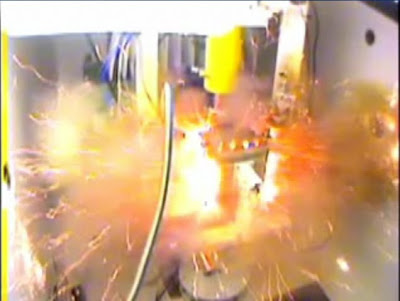
Exploding things is always fun, but did you know there is a reason for it when it comes to magnets? Scientist have been on a quest for stronger and stronger magnets ever since they knew what magnetism was. It started with perminet magnets like loadstone and neodymium. After that it was electromagnets. Although electromagnets can produce extreamly strong magnetic fields, they generate an enormus amount of heat. Because of this, electromagnets can only produce about 50,000 gauss before they melt, even with special cooling systems.
So what did scientist do to make a more powerful magnet? Well, they stuck with the electromagnet and pumped several times as much power through them as they normally would. The result was an electro magnet so powerful that it actually blew itself apart rather than just melting. After carefully analyzing the magnet power fluctuation during its short existence scientist concluded that as the magnet flew apart it lost a large amount of energy. To fix this problem, the experimenters placed high explosives around the electromagnet before they turned it on. Then, they light the explosives and turn on the magnet at the same time. The result is a magnetic field of 1000 Tesla! (That's 10,000,000 gauss!) Of course, it's gone in about 10 microseconds.
Sources:
National High Magnetic Field Laboratory:
http://www.magnet.fsu.edu/
World Book Encyclopedia, 1997 Edition

Photo courtesy of the National High Magnetic Laboratory


Astronomy Biology Botany Chemistry Geology Physics Quantum Mechanics Home

Sunday, February 28, 2010

Rock Eating Cacti

cardon cactus, links to bbc news article

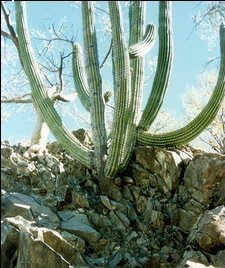
Did you know there are cacti that live on bare rocks? It's true! The giant cardon cactus of Baja Mexico not only lives on rocks, but drills its roots into them for anchorage!
young cardon cactus drilling into rocks

So how on earth does a plant accomplish this feat? The answer lies in a symbiotic relationship between the giant cardon cactus (Pachycereus pringlei) and an endophytic bacterium. The bacteria produce an acid that breaks the rock down into the minerals the the cactus needs. In return, the cactus allows the bacteria to live in its roots, suppling them with water, carbon and shelter. The acid that the bacteria make also allows the cactus's roots to bore into the rock by dissolving it. This process not only benefits the cacti and bacteria, but also breaks the rock down into soil at an accelerated rate so that other vegitation can grow there.
To continue the mutual symbiosis, P. pringlei "packages" the bacteria with it seeds. The seeds are then spread via bat or bird droppings which supply the young cardon cacti with nutrients until the bacteria can establish themselves.

Sources:
http://thenewcreationism.wordpress.com/2009/09/02/rock-dissolving-bacteria-in-desert-cacti/
http://news.bbc.co.uk/earth/hi/earth_news/newsid_8209000/8209687.stm
http://worldwidescience.org/
http://www.sciencedirect.com/science/journal/00988472

All images courtesy of BBC News

Astronomy Biology Botany Chemistry Geology Physics Quantum Mechanics Home

Sunday, February 14, 2010

Quark Quirks

Can you imagine 3 marbles floating around the vastness of outer space? If you can, you can imagine the inside of a proton.

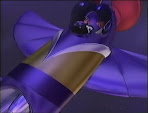
artistic impression of a quark

Protons, although tiny, are not the smallest particles around, the quark is. To give you an idea of just how small a quark is, imagine a pea orbiting a baseball 20 miles away. That is the atom. Now take that baseball, magnify to the size of the Milky Way, and drop a marble in there. The marble is the quark. Starting to get the picture? I'm just getting a headache! In fact, quarks are so small they may have no size at all! Scientist refer to them as point-like-objects.
Quarks come in 3 different varieties: up, down, charm, strange, top and bottom. Up and down quarks are the ones that make up protons and neutrons. The up quark has a positive charge of 2/3, and the down quark has a negative charge of 1/3. Quarks are never found alone, they always come sets. The most common sets are baryons, which are three quark combinations that include protons and neutrons. The neutron has 1 up quark and 2 down quarks giving it an overall charge of 0. A proton, on the other hand, has 2 up quarks and 1 down quark giving a positive change of 1.
The other four types of quarks are much more massive than up and down quarks, and therefore less stable. The top quark is the most massive of all quarks. It has a mass roughly equivalent to a gold atom, and can remain in existence for more than a billionth of a second!
Here's an fun thing to leave you pondering: according to leading theories, the three quarks in a proton are not alone, but surrounded by "virtual quarks" that blink in and out of existence!

Sources:
World Book Encyclopedia, 1997 Edition
World Book Encyclopedia, 2008 Edition


Astronomy Biology Botany Chemistry Geology Physics Quantum Mechanics Home

Saturday, February 6, 2010

Mass Concentrations

gravity map of antarctica

Back in 1967 NASA was shocked when they observed a new lunar satellite orbiting the moon in an irregular pattern. The satellite would be orbiting normally, and then dip toward the moon's surface without warning, gain speed, and shoot back up into normal orbit. Investigation of this problem led to the discovery of mass concentrations.
Mass concentrations or "mascons" are just that, concentrations of mass. The word can be used in different ways, but the most common refers to a large pocket of high density matter on or under the surface of a terrestrial body. In the moon's case, mascons are 6km thick sheets of basalt which form the maria.
lunar gravity map

Now that I have explained a little of what mascons are, I can tell you what they do. Because mascons have more mass than the surrounding crust, they have a greater gravitational pull. This is why things orbiting the moon dip and sway as they pass over a mare; the mare's mascon is pulling the satellite out of orbit. Because of this, spacecraft cannot safely orbit the moon for more than 2 months*. (Luckily NASA discovered this before they sent people to the moon.)
Believe it or not, the Earth has mascons too! They are not as extreme as the moon's, but still do change the weight of objects over them. Two of the largest and strongest are Hawaii and a large crater in Antarctica.
satellite view of hawaii

*There are four stable orbits around the moon that do not pass over mascons, and safe orbits can be achieved over mascons with the aid of computers and rockets.
Sources:
http://science.nasa.gov/headlines/y2006/06nov_loworbit.htm
http://earthobservatory.nasa.gov/IOTD/view.php?id=6862
Word Book Encyclopedia 1997 Edition
http://www.higp.hawaii.edu/

Top two photos courtesy of NASA
Lower photo from Google Earth

Astronomy Biology Botany Chemistry Geology Physics Quantum Mechanics Home